
Re-introductions
In one of my earlier Bird Notes, on Gravel Workings, I commented on the spread northwards from the south coast of Egrets. Little Egrets have been moving northwards for several years and are easily seen in our area. There is usually one in the Welland below Uffington Bridge and I recently spotted one flying over Ufford village. Now they are being joined by Great Egrets and Cattle Egrets. These are natural expansions following on from that of the Collared Dove which first bred in Britain in 1955 and is now pretty much ubiquitous.In other instances it has been decided to give nature a helping hand and re-introduce species which have previously been prevalent but have died out. One such is the Red Kite which is one of the most noticeable birds in our area. Its recent proliferation started from a reintroduction programme in Wales, the Chilterns and in Rockingham Forest and its numbers have grown from some 400 pairs in 2000 to over 1800 pairs today.
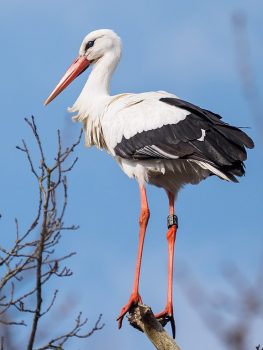 Currently, two very exciting re-introduction programmes are taking place in the south of England. A small group of private landowners and nature conservation bodies are attempting to re-introduce the White Stork which last bred in Britain in 1416. One of the landowners is the Knepp Estate in West Sussex where Isabella Tree – author of the best-selling book “Wilding” – and her husband, Charlie Burrell, are attempting to re-wild their 1400 hectare farm after decades of intensive agriculture. The book describes how, since 2001, they have had spectacular results in terms of the farm’s biodiversity. In 2019 the estate was one of the patrons of the The White Stork Project” which aims to develop a population of at least 50 breeding pairs in southern England by 2030. At least 250 White Storks will be released at several sites in Sussex and surrounding counties. Cotswold Wildlife Park provides birds from its captive population and the Durrell Wildlife Conservation Trust is monitoring the releases and working with communities in around the release sites. The Roy Dennis Foundation are involved because of their expertise and track-record in bird re-introductions. The birds released last year will be supplemented annually each summer over the project period by more captive-bred birds.
White Storks are magificent birds and their range extends across Europe with 25% of the world’s population in Poland. Another stronghold is the Iberian Peninsula and if you have holidayed in Spain and Portugal you will no doubt have seen the Storks in their large twiggy nest on poles and chimneys. The Storks’ nests are also favourite nest sites for large numbers of Spanish Sparrows.
The Dennis Foundation is also a key player in the re-introduction of a second iconic species, the White-tailed Eagle, to the Isle of Wight. The eagles were last recorded in England, on the Isle of Wight, 240 years ago and are Britain’s largest bird of prey with a wingspan of up to 8 feet. The first 6 birds were released last August and up to 6 more will be released annually over the 5-year life of the project. Amazingly, one of the released young birds made a solo flight to the Thames estuary in Essex where it stayed overnight before returning. Sadly, its tag failed and it has not been found. Another was also found dead on the Isle of Wight, a reminder of how difficult re-introductions can be. In January, however, came news that a third bird has been living inland for four months, in Oxfordshire, associating with Red Kites from whom it will be learning how to forage and survive.
However, whilst these iconic species are given a second chance, the future for many of our “common” species remains one of continuing decline and bringing them back from the brink is still proving to be an extremely difficult conundrum.
KEITH LIEVESLEY