
One of the very first native wildflowers to bloom in spring. The first flowers start to open in February and can form abundant carpets by March to April. Found in churchyards, verges, woods, meadows and hedgebanks usually on slightly damper soil.
It has rosettes of long-stalked, glossy, heart-shaped leaves which can have paler or darker concentric inner markings. The flowers in bright buttercup yellow appear singly on long stalks 10-30 cm across with 7-12 narrowly oval petals. The flowers often fade to whitish as they go over. Grows about 15cm high.
Found in Bainton churchyard, the village verges in Bainton and Ashton and along the wide County Wildlife Site roadside verges between Bainton and Ashton.
The name celandine is said to come from the Greek chelidon which means, a swallow. Perhaps as a harbinger of spring, it was seen as the flower equivalent of the return of swallows in spring-time.
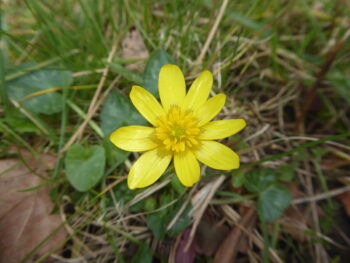
One of the very first native wildflowers to bloom in spring. The first flowers start to open in February and can form abundant carpets by March to April. Found in churchyards, verges, woods, meadows and hedgebanks usually on slightly damper soil.
An old name, no longer used is pilewort – the herb given for haemorrhoids, based on the resemblance of its knobbly tubers to piles! John Clare used the name pilewort in some of his later poems, perhaps influenced by the residents of the asylum in Northampton.
John Clare called lesser celandine his ‘crowflower’ and ‘buttercup’, writing that children in Helpston held the shimmering flowers under their chin to see who would grow rich. I guess the children in Bainton did that too!
‘It comes early and glads the shepherds eye
Like a bright star spring-tempted from the sky
Reflecting on its leaves the suns bright rays
That sets its pointed glories in a blaze’ John Clare