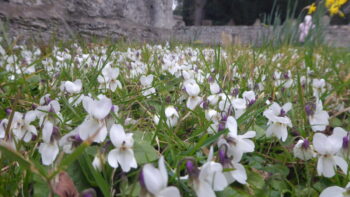

A British native species, the only scented violet. Flowering locally from early March to April. Sweet Violet is fairly common on hedgebanks and in scrub and open woodland and is often found naturalised in churchyards. Tends to prefer lime-rich soils.
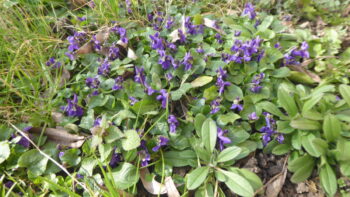
One of the delightful first flowers of spring. In Bainton, Sweet Violets are found in the churchyard and on the village verges and green spaces. Most of the Sweet Violets in Bainton are white (variety alba) or a pale apricot colour form (var. sulfurea) which is quite rare. The apricot coloured sweet violets were first found in the churchyard but are spreading to other grassy areas nearby. In Ashton the sweet violets are mauve forms.
There is a small patch of the larger dark purple garden form on the verge in Church Lane behind the church.
The scent of Viola odorata flowers can be very strong. They have been used for making perfume for more than 2000 years. In Medieval times sweet violets were used as a strewing herb, a kind of household deodorant. But strangely the scent can seem to fade quickly, this is the result of one of the chemicals which makes up the scent, called ionine. The ionine temporarily deadens our sense receptors so that we can’t detect the scent.
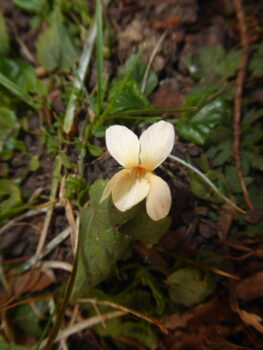
Common dog-violets are also found in Bainton churchyard too but tend to start flowering a bit later. The flowers are unscented – ‘dog’ to distinguish it from the ‘sweet’ species’.
Sweet Violets – leaves and flowers all grow directly from a central point, with the flowers on leafless stems.
Common Dog Violet – heart shaped leaves that are mostly in a non–flowering rosette, with the flowers on leafy stems.
‘And just to say that spring was come,
The violet left its woodland home,
And, hermit-like, from storms and wind
Sought the best shelter it could find,
Neath long grass banks, with feeble flowers
Peeping faintly purple flowers.’ from Holywell, John Clare