
“They’ve been coming here for hundreds of years!” were amongst the first words said to me in my new home in Ufford in 2002. I’d moved into a new house which included the cow shed from the old Newport Farm.I was told that it was nested by swallows.
As a city boy I confess that the nesting habits of swallows had little interest for me. In fact, living in a village was something of an experiment after 40 years of town life.
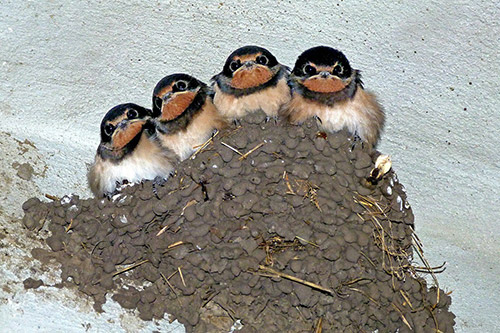 But that Spring my views changed for ever. One morning, minding my own business, a blue flash darted passed me at head height faster than my eye could follow. And then another soaring into the bright, clear sky and out of sight. The swallows were back. The speed! The Colour! The sound! I was hooked.
I learnt that British swallows spend their winter in South Africa covering 200 miles a day, mainly during daylight, at speeds of 17-22 miles per hour. The maximum flight speed is 35 mph. How is that possible?
They arrive herein April and May, returning to their wintering grounds in September and October. I watched as two pairs arrived. One moving into an existing nest high up in the eaves. The other building one from scratch. My cat ducking as they dive bombed her and like a Harrier jet turning on a sixpence and off and away.
But it wasn’t only my birds I watched. I noticed that the skies were heavy with these supersonic birds dancing and soaring and playing and feeding.A great delight was to lie down outside on a summer’s evening and watch them high above trying to count them. I could easily find 50 in the sky.
This became an annual ritual. I would eagerly await the arrival of my friends. But gradually as the years passed,I noticed that there seemed to be fewer in the sky. Was it my eyesight or was it real I wondered? It was real. So much so that in recent years I could only spot a handful.
And, finally, disaster. Last year no one arrived in the cow shed. I’d spot the occasional swallow up high and wondered if they had got bored with my hospitality.
 I found some explanations. Some people blame insecticides. Less insects to eat.But most worrying was to read of huge mist nets in various countries which capture them before they are killed.For example,700 kilometres of nets on the Egyptian coast and in the Nile Valley. Similar in Cyprus.What chance had my friends of making it there and back to Ufford? So that was that.
Then just as lockdown hit this year, I saw something fly past into the cow shed. Surely not? It can’t be? But it was! They were back!
Only one pair but there they were. Soon busy on a new nest. I stood outside a madman, arms outstretched like a scarecrow and they did what they often used to do. Zooming around me and past my arms with that unmistakeable warble as if to say “Hello! We’re home”. I don’t mind admitting that I cried.
For now, one pair and still few others in the sky. And I worry whether they are being bullied by the huge pigeons. Hopefully, some chicks will emerge.
Then I asked them the question I always have: “How can you fly 6000 miles back to this tiny cow shed in the middle of nowhere and find it? “. They never answer. I’m just glad that they know how.
Chris Boucher